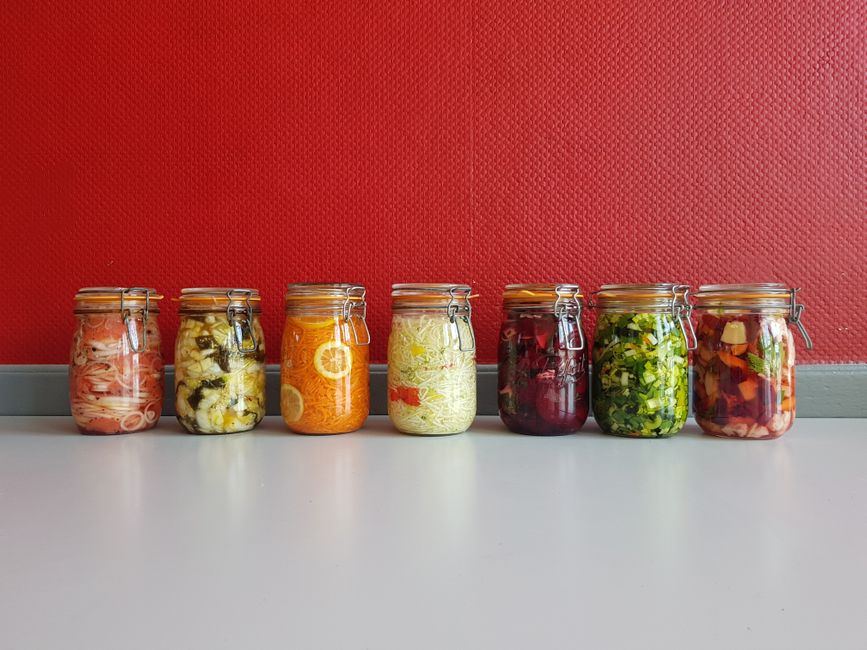
Sales of fermented food products across Belgian specialty retailers rose roughly 34 percent between 2023 and 2025, according to figures from Comeos, the Belgian retail federation. In Brussels, that trend is visible on the shelves of everything from organic supermarkets to neighbourhood delis — and the science behind the surge is becoming harder to ignore.
Interest in gut health has been building for several years, driven partly by a wave of research linking the gut microbiome to everything from immune function to mood regulation. The European Food Safety Authority has been cautious about what specific health claims manufacturers can attach to probiotic products, but clinicians and registered dietitians across Belgium have been increasingly frank with patients: diversity of fermented foods in the diet, consumed regularly, appears to support microbiome diversity. That matters. A 2021 Stanford University study published in Cell found that a 10-week high-fermented-food diet increased microbiome diversity and decreased markers of inflammation in participants. The evidence isn't perfect, but it's substantive enough that Brussels' wellness community has taken it seriously.
Where to find the good stuff in Brussels
Start at Marché du Châtelain, the Wednesday market on Place du Châtelain in Ixelles. Several stalls there sell raw, unpasteurised sauerkraut and kimchi made in small batches in and around the capital. The distinction matters: pasteurised versions, common in supermarkets, kill the live bacteria that produce the probiotic effect. Look for jars labelled non pasteurisé or levain naturel. Prices run around €5 to €8 for a 400-gram jar of local kraut — more than the supermarket equivalent, but you're paying for live cultures.
Färm, the Belgian organic supermarket chain with branches on Rue Lesbroussart in Ixelles and on Chaussée de Waterloo in Saint-Gilles, stocks a curated selection of fermented products year-round. Their refrigerated section carries kombucha from Brussels-based producer Booch Brothers, raw apple cider vinegar, and a rotating selection of naturally fermented pickles. Staff at the Rue Lesbroussart location are notably well-briefed on the difference between traditionally lacto-fermented vegetables and vinegar-brined ones — only the former contains live bacteria.
For kefir — fermented milk drink with a tart, yoghurt-like profile — the covered Marché de Saint-Gilles on Place Maurice Van Meenen carries at least two dairy vendors who produce it on-site. Water kefir, a dairy-free alternative fermented with sugar water and kefir grains, is sold by at least one vendor at the weekend Marché du Midi on Avenue Fonsny, the largest market in Belgium, which draws more than 10,000 visitors on a typical Sunday morning.
Building a fermented food routine without overcomplicating it
The common mistake is going all-in immediately. Gut specialists in Brussels and elsewhere routinely advise patients to introduce fermented foods gradually — starting with a tablespoon of sauerkraut or a 100ml glass of kefir daily for the first two weeks, then scaling up. Sudden large quantities of fermented food can cause bloating and discomfort, especially if your current diet is low in fibre and your microbiome is not yet accustomed to the bacterial load.
Miso deserves a specific mention. The Japanese fermented soybean paste is easy to find at Zenniku, the Japanese grocery on Rue Léon Lepage near Sainte-Catherine, and it survives well in a domestic kitchen for months. Stir it into warm — not boiling — water to preserve its live cultures, add a handful of wakame seaweed and some tofu, and you have a functional breakfast in under five minutes.
Tempeh, the Indonesian fermented soybean block, is increasingly stocked at both Färm locations and at the Bio-Planet on Boulevard de la Woluwe in Woluwe-Saint-Lambert. Unlike tofu, tempeh is a whole food with a binding structure created by fermentation itself — it's higher in protein per gram and retains the soya's fibre intact. Pan-fry it with a little tamari and garlic and it holds its own against any meat-based lunch.
Anyone with underlying digestive conditions — irritable bowel syndrome, Crohn's disease, or a compromised immune system — should speak with a gastroenterologist or registered dietitian before significantly changing their fermented food intake. The general population, though, has rarely had better local access to these foods. Brussels' markets and specialist retailers make starting simple.