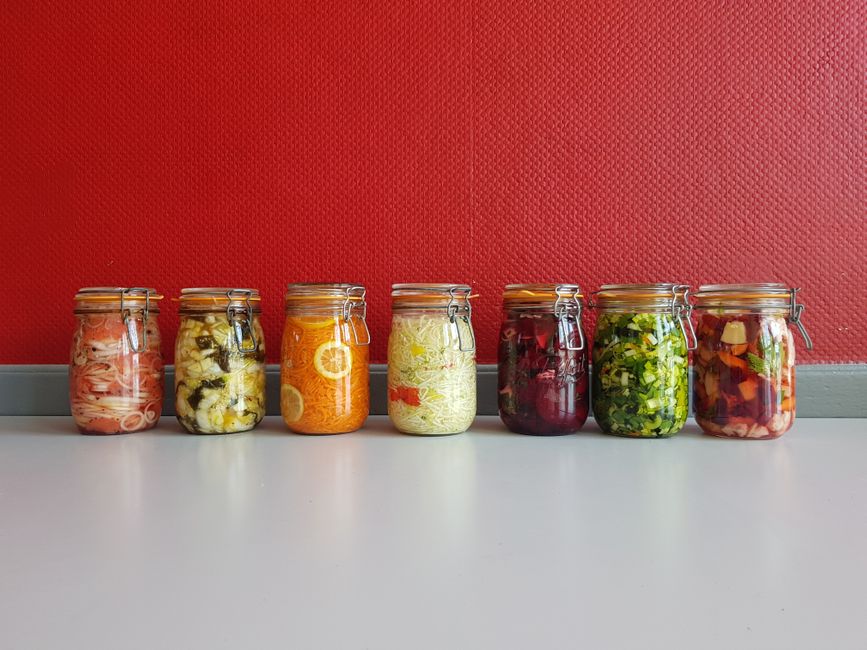
Fermented foods are no longer a niche obsession for the health-obsessed. Walk through the Place du Châtelain market on a Wednesday afternoon and you will find at least four stalls selling live-culture products — raw-milk cheeses, naturally fermented pickles, kombucha on tap. Demand has pushed Brussels retailers to expand their fermented ranges by roughly 30 percent over the past two years, according to figures cited by Bio-Planet, the organic supermarket chain with a flagship store on the Chaussée de Waterloo in Uccle.
The timing matters. European gut-health research has accelerated sharply since the Human Microbiome Project published its expanded dataset in 2023, and mainstream awareness is catching up. A 2025 survey by the Belgian Health Interview Survey found that 41 percent of adults in the Brussels-Capital Region reported digestive complaints at least once a week — bloating, irregular digestion, post-meal fatigue. Dietitians working at clinics along the Rue Belliard are fielding more questions about the microbiome than about any other single nutritional topic. Fermented foods, it turns out, are one of the most evidence-backed and accessible ways to support it.
What to look for — and where to find it in Brussels
Start with the basics. Kefir, a fermented milk drink with a tart, slightly fizzy profile, contains anywhere from 12 to 60 distinct probiotic strains depending on the culture used. La Ferme Nos Pilifs, the social-enterprise farm operating on the edge of the Laeken district in Brussels, sells its own kefir at the Gare du Midi weekend market every Saturday. A 500ml bottle runs about €3.80. Nos Pilifs also produces naturally fermented vegetables — their lacto-fermented carrot and ginger jar has developed something of a cult following among the commune's running clubs.
Kimchi has become reliably available in Ixelles, particularly around the Chaussée de Boondael, where Korean-owned grocers stock multiple brands alongside house-fermented batches. For something more Belgian, look to Ferme de la Verte Voie in Overijse — just outside the Region's border but widely distributed to health food shops in Etterbeek — which produces a raw sauerkraut fermented for a minimum of 21 days. Raw is the operative word: pasteurised sauerkraut, which lines most supermarket shelves, has had its live cultures killed off by heat. Check the label. If it does not say «non pasteurisé» or «raw», the probiotic benefit is largely gone.
Kombucha has expanded fastest. Booch, a Brussels-based brewery operating out of Molenbeek since 2022, now distributes to over 80 cafés and restaurants across the 19 communes. Their ginger-lemon blend, retailing at roughly €4.50 for 330ml at stockists including Färm in Saint-Gilles, consistently tests at around 1 to 2 billion colony-forming units per serving — a meaningful dose by clinical standards, though researchers caution that CFU counts alone do not tell the whole story.
Making the most of what you buy
Diversity matters more than quantity. A 2021 Stanford University study, frequently cited in gut-health literature, found that participants who ate a high-variety fermented diet for 10 weeks showed significantly increased microbiome diversity compared with a high-fibre group — suggesting that rotating your fermented foods is more beneficial than eating large amounts of one type. In Brussels terms: do not just default to the same kombucha. Rotate. Add miso — readily available at Tagawa on the Rue de Flandre in the centre — to soups. Try tempeh from the Supermarché Asiatique near Gare du Nord.
One practical note: fermented foods work best alongside a diet that gives those bacteria something to eat. Prebiotic fibre — found in chicory (Belgium grows roughly 80 percent of the world's supply for inulin extraction), garlic, leeks and artichokes — feeds the microbes that fermented foods introduce. The combination is not complicated. It just requires intention.
Anyone managing a specific digestive condition, taking immunosuppressants or dealing with histamine intolerance should speak to a gastroenterologist or registered dietitian before significantly increasing fermented food intake. The Centre Hospitalier Universitaire Saint-Luc on the Avenue Hippocrate has a dedicated digestive health consultation service. For everyone else, Wednesday at Châtelain is a perfectly reasonable place to start.